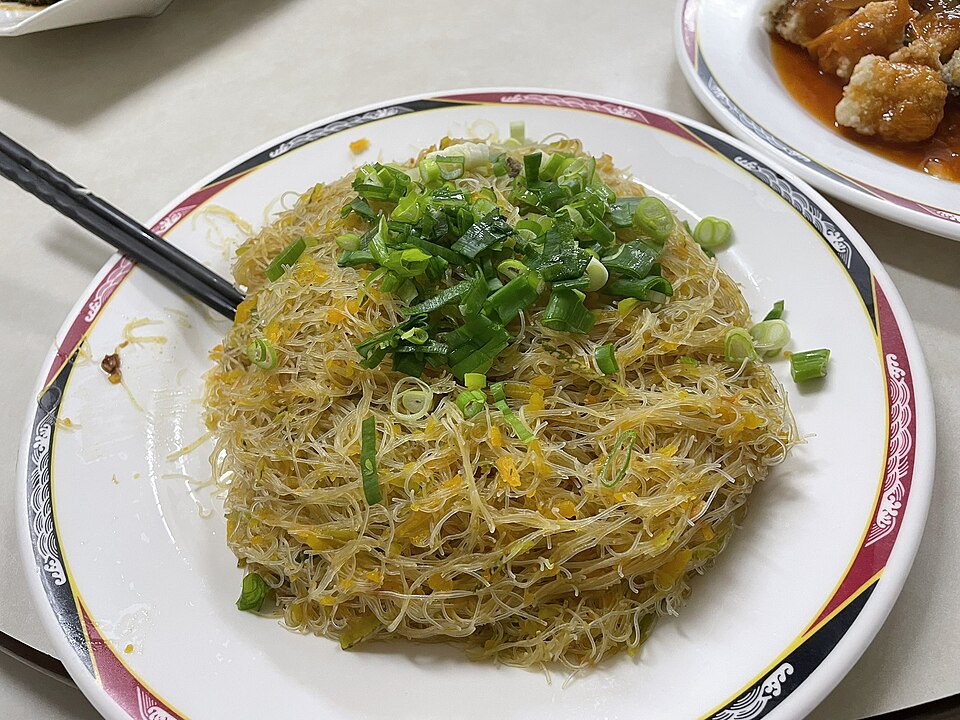
What it is
Thin rice vermicelli (米粉) stir-fried with shredded pumpkin until the noodles turn golden. The Taiwanese name, kim-kue bí-hún (金瓜米粉), uses 金瓜, "golden melon", the local word for pumpkin; in Mandarin it may be called 南瓜米粉. A good plate is savoury with a sweet edge and not oily, and the pumpkin keeps some shape.
How it is made
The vermicelli is soaked to soften it. Garlic, shallots and dried shrimp or dried squid go into a hot wok, followed by the shredded pumpkin, which softens and gives up its juice. The noodles go in last and are tossed until evenly coated. Little or no stock is needed, since the pumpkin's moisture steams and seasons the noodles. Some cooks add shredded pork, and seafood restaurants may add fresh shrimp or small squid.
How to eat it
It is a shared plate rather than a meal for one, ordered as the starch alongside seafood such as a steamed fish. It is a regular at rechao (熱炒) stir-fry restaurants, where a group orders several dishes for the table.
Around Taiwan
- Kaohsiung
- On Cijin island, Haibin Seafood (海濱海產) beside the Zhongzhou ferry pier is best known for an old-style version: springy noodles, pumpkin that holds its shape, and little grease.
- Outlying islands
- Penghu cooks use island-grown pumpkin. Rixin Restaurant (日新餐廳) in Magong treats it as its signature, stir-frying the pumpkin with local seafood, shrimp, small squid and shredded pork. It comes with every group set menu, in large portions.