What it is
Hsinchu rice noodles (新竹米粉) are dried noodles from Hsinchu City in northern Taiwan. They come in two kinds. Water noodles (水粉) are short and coarse, closer to the original form, and usually go into soup. Steamed noodles (炊粉) are fine strands steamed before drying, which gives them more spring. Most Hsinchu noodles now contain more cornstarch than rice.
Where it came from
Hsinchu's noodle trade began in the Qing dynasty, some time between the 1820s and 1860s. Local tradition credits Guo Quan (郭泉) and his brothers, who came from Hui'an county in Fujian. Families named Kuo, Tseng, Chen and Ho settled around Dananshi (大南勢), on flat land beside the Keya River, where rice paddies, sunshine and steady wind suited the work. The area became known as 米粉寮, the rice noodle sheds, and at its peak had more than 60 workshops.
Under Japanese rule Kuo Shu (郭樹) went back to Fujian to learn the steaming method. After the war steamed noodles spread across Taiwan.
Rice later gave way to cheaper cornstarch. A 2013 test of 52 products by the farm news site News & Market found 45 were less than half rice. Labelling rules followed in 2014. Pure rice noodles (純米米粉) must be all rice, blended noodles (調和米粉) at least half, and anything less may not be sold as 米粉. Hsinchu makers renamed their products 新竹炊粉 and 新竹水粉 until a 2016 agreement with the food regulator let the old word back.
How it is made
Rice is soaked overnight and ground into a slurry, which is packed into bags and pressed under weights to drive out water. For steamed noodles the dough is steamed only part way, since overcooked dough sticks and undercooked dough snaps. It is then pressed into strands and laid on bamboo trays to dry. The dry northeast wind (九降風) that starts after the Double Ninth Festival in autumn does most of the drying. In wet weather the trays must be carried in and out again and again.
How to eat it
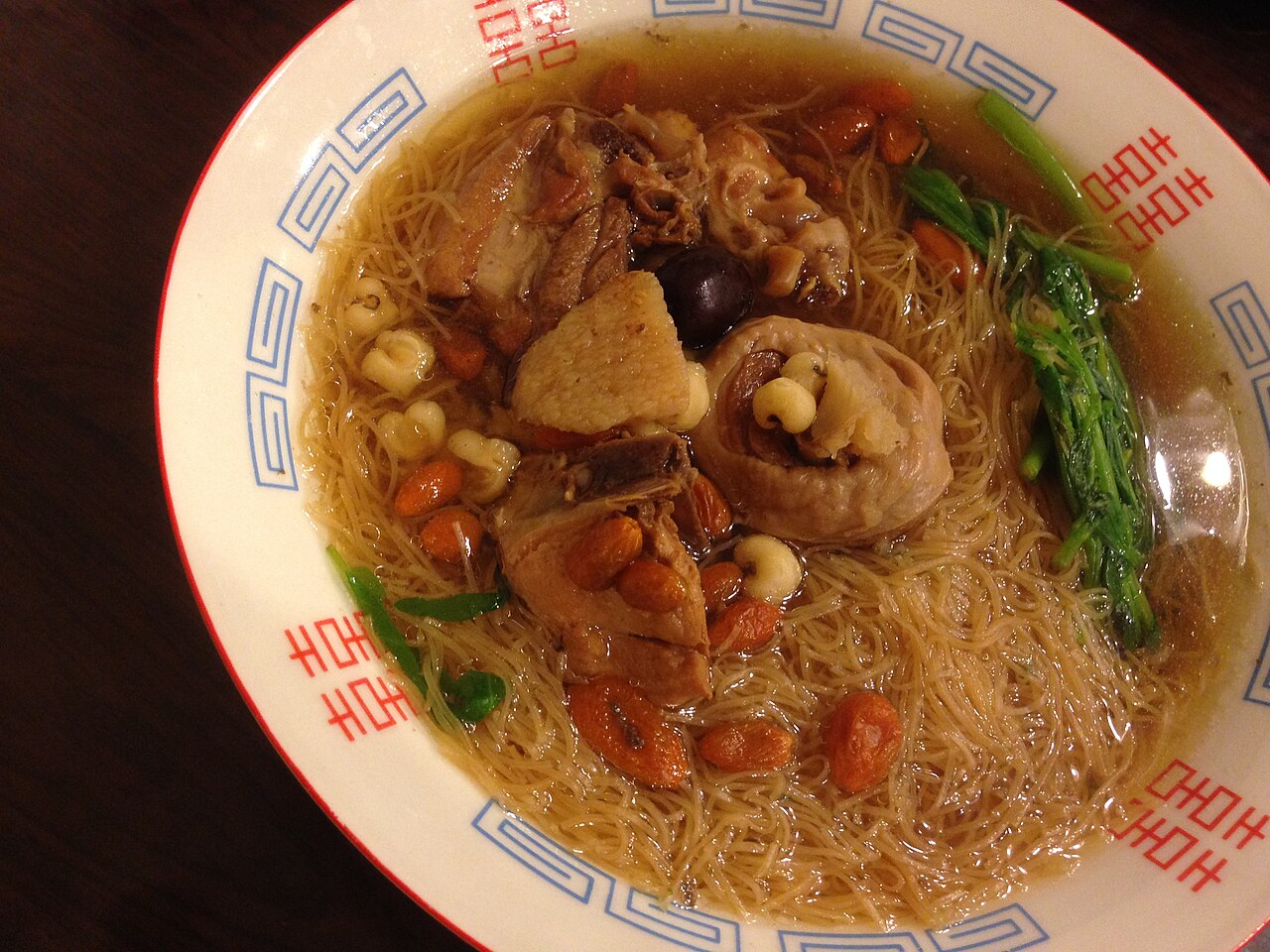
Steamed noodles are stir-fried with pork and vegetables (炒米粉) or served in soup, often with pork balls (貢丸). Water noodles are soaked first, then cooked in a meaty soup. Pure rice noodles have a soft texture and break if cooked too long. When buying, look for 純米 (pure rice) on the packet if rice content matters.
Around Taiwan
- Central
- Taiwan's labelling rules allow a few place names with a long noodle-making history on packets. Besides Hsinchu, the examples given are Puli (埔里) in Nantou, Fenyuan (芬園) in Changhua and Xiluo (西螺) in Yunlin.