What it is
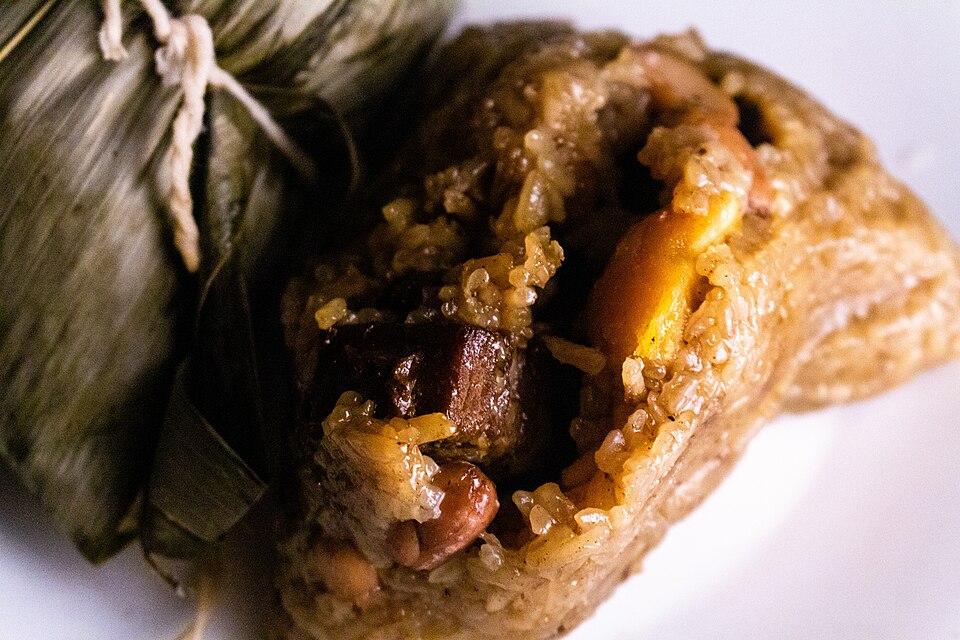
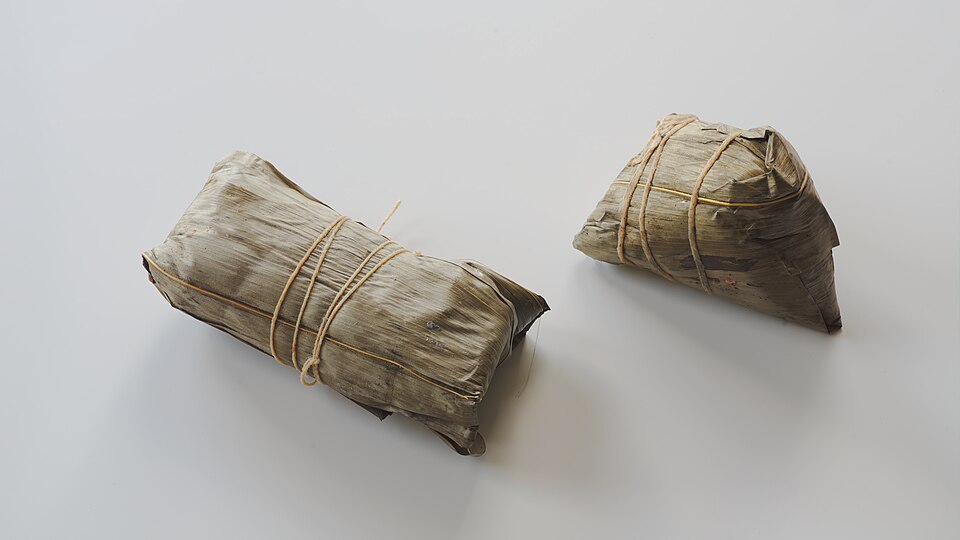
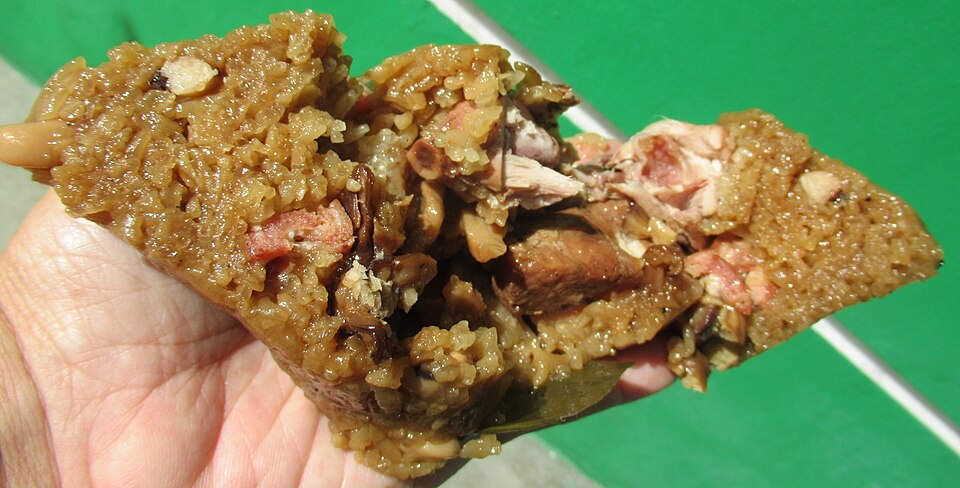
Zongzi (粽子), called bah-chàng (肉粽, 'meat zongzi') in Taiwanese Hokkien, are parcels of glutinous rice wrapped in bamboo leaves around savoury fillings such as pork, shiitake, salted duck egg yolk, peanuts or dried radish. Taiwan sorts them by cooking method rather than filling, summed up in the saying 'boiled in the south, steamed in the north' (南煮北蒸).
Where it came from
Rice wrapped in leaves is older than its best-known story. Sources differ on the earliest record. Some point to the Fengsu Tongyi of AD 195, which mentions zong at the Double Fifth festival; others to Zhou Chu's Fengtu Ji (風土記) of the late 3rd century. Early texts call the food 角黍, 'horned millet': millet wrapped in wild rice leaves into the shape of an ox horn.
The legend says people threw rice into the Miluo River so the fish would spare the body of the poet Qu Yuan, who drowned himself there around 278 BC. That link first appears in writing in the mid-5th century. In a later tale by Wu Jun (吳均), Qu Yuan's ghost asks for the rice to be sealed with chinaberry leaves and tied with coloured thread to keep dragons from stealing it. In parts of Jiangsu, zongzi were offered to Wu Zixu (伍子胥) rather than Qu Yuan.
How it is made
In the southern method, soaked raw glutinous rice and marinated fillings are wrapped together in the broad leaves of ma bamboo (麻竹) and boiled in a large pot for one and a half to two hours. Boiling makes them less greasy. In the northern method, the rice is stir-fried in oil with soy sauce, five-spice and pepper until half cooked, wrapped with the fillings in husks of makino bamboo (桂竹) and steamed.
How to eat it
Zongzi belong above all to the Dragon Boat Festival, on the fifth day of the fifth lunar month, but zongzi shops trade all year. Southern zongzi usually come with a thick sauce and peanut powder, and some diners add garlic paste or chilli oil. Ask for 菜粽 for the vegetarian peanut version, or 鹼粽 for a plain alkaline zongzi eaten with syrup or sugar, often chilled.
Around Taiwan
- Tainan
- Food writer Jiao Tong (焦桐) ranks Tainan first among southern zongzi. Zai Fa Hao (再發號), founded in 1872 and now in its fourth generation, wraps each zongzi in three leaves, two fresh ones outside a boiled one. Its seafood eight-treasure zongzi weighs 14 taels, about half a kilo.
- North
- Northern zongzi are brownish yellow, coloured by the stir-fried rice and the bamboo husk. Nanmen Market (南門市場) in Taipei sells Huzhou zongzi (湖州粽), one of the Jiangsu and Zhejiang styles that mainland migrants brought after 1949.
- Central
- Central zongzi mix the two methods: the rice is stir-fried until about a third cooked, then wrapped and boiled. They are eaten with local chilli sauces. Their squat shape has earned an online nickname after the concrete breakwater blocks (消波塊) of the Taichung coast.
- Outlying islands
- Kinmen zongzi use rice fried until half cooked but are then boiled, with dried oysters among the fillings. Matsu makes a yellow, springy alkaline zongzi with peas or peanuts, shaped like an ice-cream cone (甜筒粽).
- Hakka
- Hakka cooks make rice zongzi (米粽) from steamed glutinous rice with dried shrimp, radish and shallots, eaten cold, and 粄粽, wrapped in a dough of ground rice. Neiwan Old Street in Hsinchu County is known for zongzi wrapped in ginger lily leaves.
- Indigenous
- Paiwan, Rukai and Puyuma communities make cinavu (吉拿富): taro, millet or glutinous rice around a meat filling, wrapped first in 假酸漿 leaves, which are eaten, then in shell ginger leaves. It is sold as 'Paiwan zongzi' but has a separate origin.